Collections
A collection is a set of items that are gathered together for some purpose. A collection includes:
- a library or cultural heritage collection that provides easy and contextual access to exemplars of manifestations with characteristics in common (such as category of carrier) or which embody content with similar characteristics or subjects (such as a common language or theme)
- a bound or boxed set of exemplars of more than one manifestation, manufactured by an agent for preservation or circulation of the items
- an exhibition that associates items for education, promotion, or entertainment
The set of collected items may be fixed or it may change as a result of additions and withdrawals.
The set of collected items may include specified sub-sets of items and may be a sub-set of a larger collection.
Consider a collection to be an information resource that is a manifestation with only one exemplifier that embodies only one expression that realises a collecting work.
Consider the expression that realises a collecting work as having no intrinsic characteristics that are useful to describe. The collecting expression does not inherit the characteristics of the expressions that are embodied in the manifestations that are exemplified by the collected items, and the common characteristics of those expressions are included in the description of the collecting work. There is no utility in describing the collecting expression.
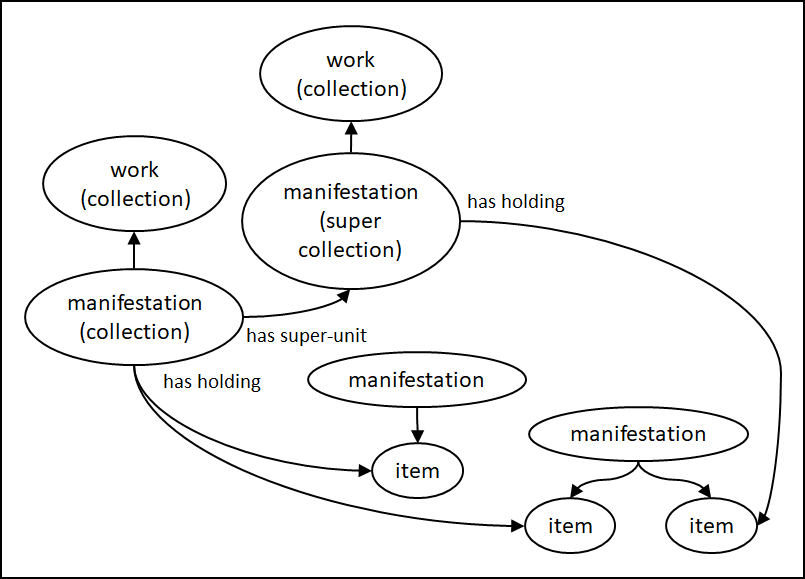
The diagram shows the resource entities and relationships that may be used to describe a collection manifestation.
Use a has holding element to relate a collection manifestation to an item that is collected.
Use a has super-unit element to relate a collection manifestation to a broader collection manifestation of which it is a part.
Record a has location of collection element to relate a collection manifestation to a place where the collection is located.
Record a has super-unit element or a has sub-unit element to relate a collection manifestation to the manifestation of a super-collection or a sub-collection, respectively.